
Why Traditional Rubrics Fall Short
Traditional grading rubrics are static documents. They define criteria and point allocations, but they can't adapt to the nuanced ways students express their understanding.
A student might use different terminology, structure their answer uniquely, or approach a problem from an unexpected angle. Traditional rubrics — and the humans using them — often struggle to fairly evaluate such responses.
Enter Adaptive Rubrics
GenEval's Adaptive Rubric System represents a fundamental shift in how we think about evaluation criteria. Instead of rigid keyword matching, our system:
1. Understands Semantic Equivalence
When a rubric says "explain photosynthesis," our system recognizes that a student describing "how plants convert sunlight to energy" is answering correctly — even without using the word "photosynthesis."
2. Maps Answer Structures Dynamically
Students don't always follow the expected answer structure. Some write conclusions first. Others embed key points within tangential discussions. Our AI identifies relevant content regardless of organization.
3. Calibrates to Subject Context
Physics answers require different evaluation criteria than history essays. GenEval automatically adjusts its interpretation based on the subject matter, question type, and academic level.
How It Works Under the Hood
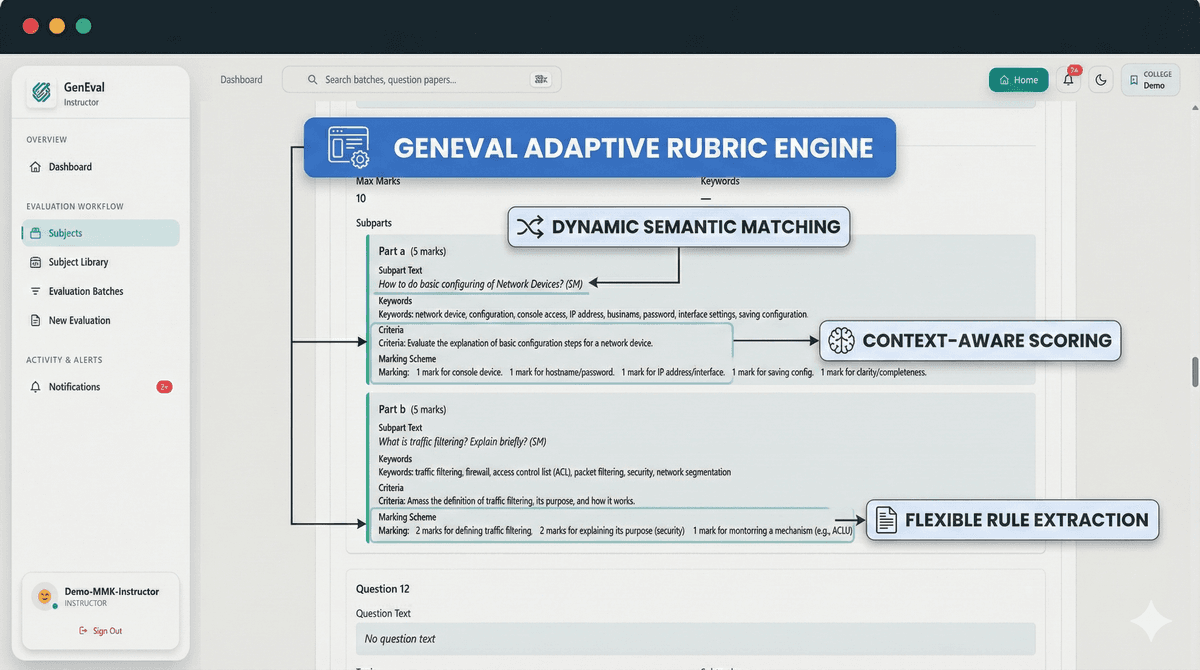
GenEval Adaptive Rubric Interface
Input: Question Paper + Answer Key + Rubric
                    ↓
         Rubric Analysis Agent
                    ↓
     Semantic Criteria Extraction
                    ↓
      Flexible Matching Rules
                    ↓
    Context-Aware Scoring Model
The Rubric Analysis Agent breaks down each marking criterion into:
- Core Concepts: The essential ideas that must be present
- Supporting Points: Additional details that enhance the answer
- Quality Indicators: Signs of deeper understanding
- Negative Indicators: Common misconceptions to watch for
Real-World Example
Question: Explain the causes of World War I (10 marks)
Traditional Rubric:
- Assassination of Archduke Franz Ferdinand (2 marks)
- Alliance system (2 marks)
- Nationalism (2 marks)
- Imperialism (2 marks)
- Militarism (2 marks)
Problem: A student who writes brilliantly about the complex interplay of European rivalries but uses different terminology might lose marks unfairly.
GenEval's Adaptive Approach:
- Identifies semantic equivalents ("killing of the Austrian heir" = assassination)
- Recognizes related concepts ("competing empires" = imperialism)
- Awards partial credit for incomplete but accurate explanations
- Values synthesis and original analysis
The Results
Institutions using Adaptive Rubrics report:
- 32% reduction in revaluation requests
- 45% faster rubric creation time
- 89% agreement rate with senior evaluator assessments
- Higher student satisfaction with feedback quality
"The system doesn't just grade — it teaches our faculty how to write better rubrics." — Dr. Sharma, Academic Dean
Getting Started
Adaptive Rubrics work best when you provide:
- Clear answer keys with multiple acceptable variations
- Marking schemes that prioritize concepts over keywords
- Sample answers at different grade levels (optional but helpful)
Our onboarding team helps you optimize your existing rubrics for GenEval's semantic engine.
Fair grading isn't just about consistency — it's about recognizing understanding in all its forms. Adaptive Rubrics make that possible at scale.